 CrossCheckTCG
Front and back, measured where it counts
How CrossCheck measures a card's centering from the grading company's images of the slab, the way graders judge it.
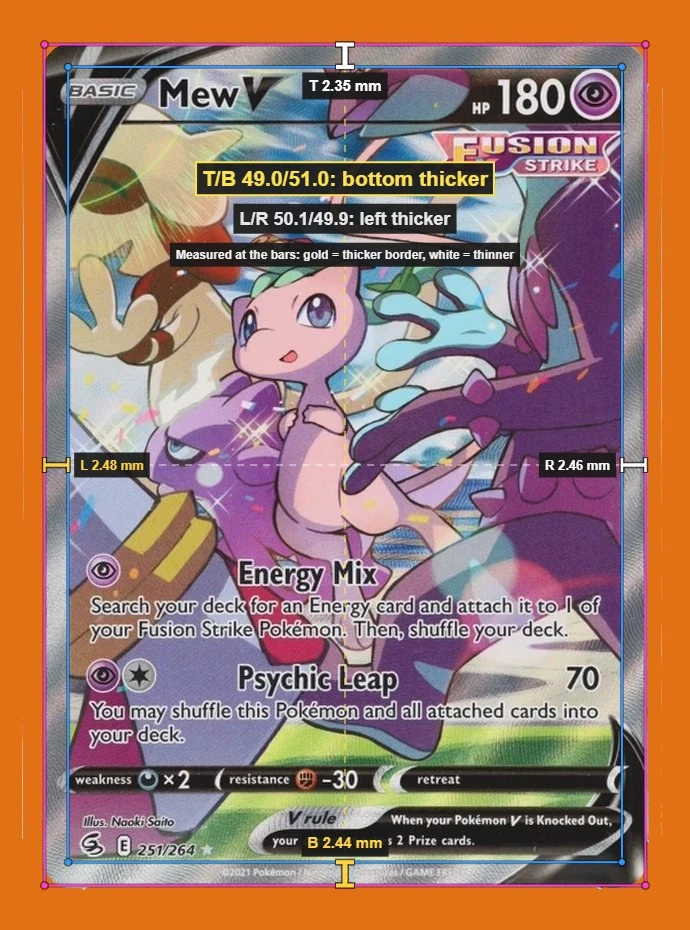
Measured where it counts
Centering is often what stops a slab crossing to the top grade at another company. CrossCheck straightens the grading company's image of the card, finds the card's edges and its printed border, and compares each pair of opposite borders, as graders do.
- Top/bottom and left/right, taken at the worst point when a border is thicker at one end
- The picture shows exactly where each border was measured, and which pair decides
- Knows the awkward ones: VMAX, TAG TEAM, Pokémon-GX, e-Reader and RGB cards

The back counts too
Graders judge the back's centering as well, usually with more room than the front: PSA allows up to 75/25 there for a PSA 10. Grading companies photograph the backs of their slabs, so CrossCheck measures the back the same way as the front: from the card's edge to the inner edge of the blue border, pair by pair, at the worst point.
- For a PSA 10: within 72.5/27.5 the back holds nothing back; up to 75/25 it's a close call; past it, a PSA 10 is out
- Japanese gold backs too, measured to the middle of the gold-to-blue fade
- Its own picture, and its own lines in the Adjust editor: flip the card with one click
Know if it'll cross before you buy
The supporting data for your next crossover, without the slab in your hand. Join the waiting list with your Google account: we'll let you in as places open.